
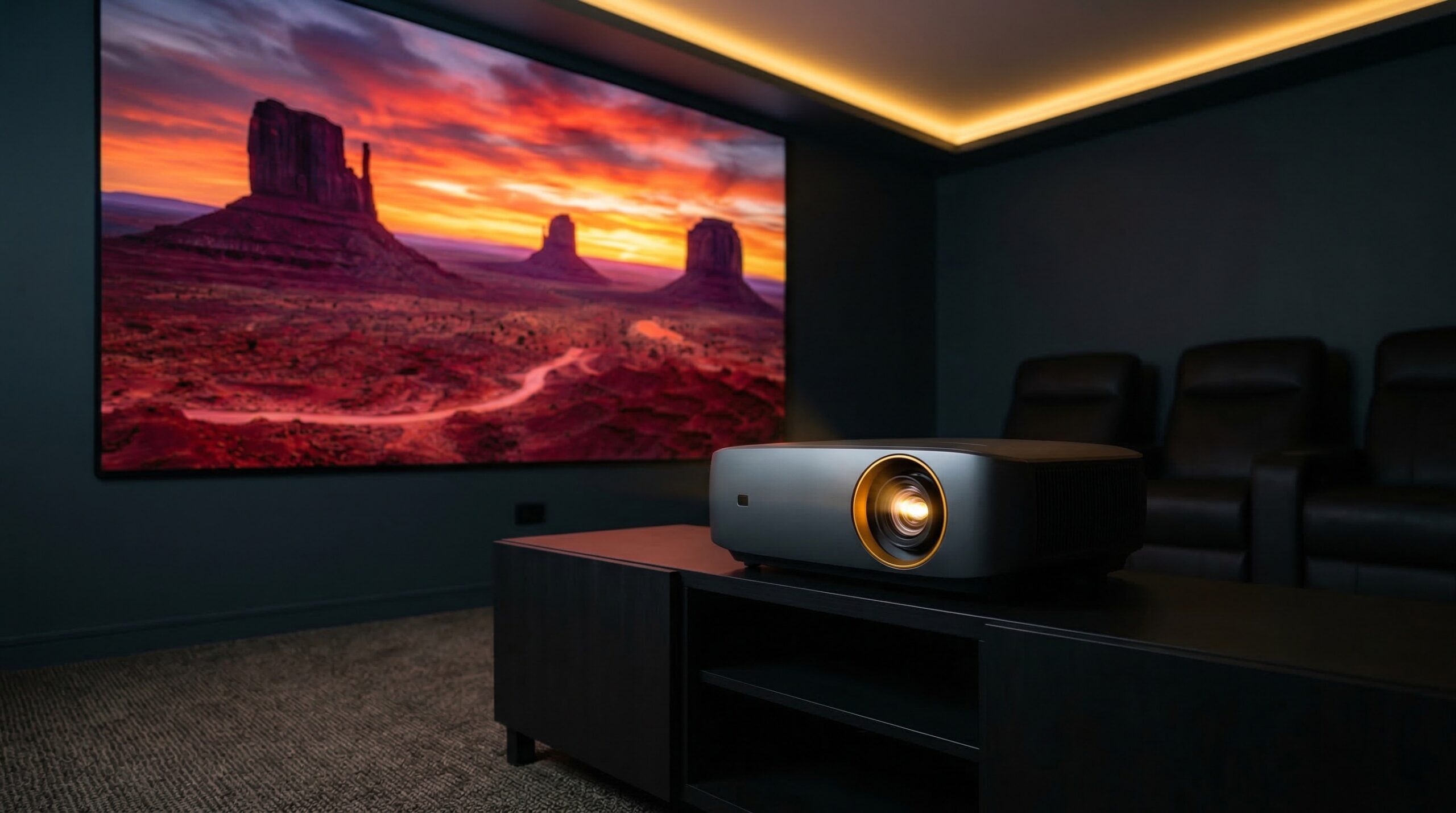
Need to Know
Finding the right short throw or ultra-short throw (UST) projector is about matching your room’s light levels and your tolerance for technical quirks like the “rainbow effect.” For most living rooms, the Hisense PX3-Pro offers the best balance of color and brightness. If you have a dedicated dark room, the Nexigo Aurora Pro leads with superior black levels. Gamers should look toward the Epson LS800 for its remarkably low input lag, while those on a budget can still get a massive screen with the BenQ TH671ST. Always remember that for UST projectors, an ALR screen isn’t just an accessory—it’s usually a requirement for a quality image.
After testing dozens of home theater configurations in spaces ranging from cramped apartments to dedicated basements, I’ve learned that the “best” projector depends entirely on your floor plan. A massive 120-inch screen is a thrill, but only if the projector doesn’t become a noisy, washed-out distraction in your living room. In this guide, I’ll break down which models actually earn their keep and which ones might leave you frustrated with setup hurdles.
Understanding the Tech: Short Throw vs. Ultra Short Throw (UST)
The main difference between these two comes down to distance. A Short Throw projector usually sits about 3 to 5 feet away from your screen. They are great for small rooms where you can place the unit on a coffee table. Ultra Short Throw (UST) projectors, often called “Laser TVs,” sit just inches away from the wall, usually on a media console.
While USTs are more convenient because they don’t require ceiling mounting or long cable runs, they are incredibly sensitive. Because the light hits the screen at a steep angle, even a tiny bump in your wall will look like a giant wave in the image. This is why browsing our projectors hub is helpful for understanding how throw ratios impact your specific room layout. If your walls aren’t perfectly flat, a traditional short throw might actually be the safer bet.
| Product Name | Best For | Price Range | Pros/Cons | Visit |
|---|---|---|---|---|
| Hisense PX3-Pro | Best Overall UST | Check price on Amazon | Excellent color; Lacks built-in Netflix | |
| Nexigo Aurora Pro | Dark Room Cinema | Check price on Amazon | Best-in-class blacks; Software can be buggy | |
| AWOL Vision LTV-3500 Pro | Bright Living Rooms | Check price on Amazon | Insanely bright; High price tag | |
| Epson EpiqVision Ultra LS800 | Gaming & Low Lag | Check price on Amazon | Lowest input lag; Bulky chassis | |
| Formovie Theater Premium | Cinematic Color | Check price on Amazon | Dolby Vision support; Average gaming lag | |
| Valerion VisionMaster Max | Premium Short Throw | Check price on Amazon | Versatile placement; Newer brand name | |
| BenQ X500i | Mid-Range Gaming | Check price on Amazon | 4K pixel shift; Limited vertical shift | |
| Hisense C2 Ultra | Console Gaming Flex | Check price on Amazon | Gimbal stand is great; Large footprint | |
| BenQ TH671ST | Budget Gaming | Check price on Amazon | Great value; 1080p only |
Best Ultra Short Throw (UST) Projectors (Laser TVs)
Hisense PX3-Pro
The Hisense PX3-Pro is currently the projector to beat if you want a complete TV replacement. Its TriChroma laser engine covers a massive color gamut, making HDR content pop in a way that rivals high-end OLEDs. In practice, this unit delivers stunning 4K clarity, and the contrast is significantly improved over previous generations. It’s a well-rounded machine that handles everything from daytime sports to late-night movies with ease.
Pros
- Incredible color accuracy and vibrancy thanks to the triple laser setup.
- Very high peak brightness that works well with ambient light.
- Improved contrast ratios that make dark scenes much more legible.
Cons
- The smart platform lacks a native Netflix app, requiring an external streaming stick.
- Some users report “laser speckle” (a slight grainy texture) on bright, uniform surfaces.
Our Take: Best for movie lovers who want a vibrant, high-contrast image that can handle a bit of ambient light. Skip if you hate using external streaming sticks.
Nexigo Aurora Pro
If you have a dedicated theater room with blackout curtains, the Nexigo Aurora Pro is a revelation. While most USTs struggle with “inky” blacks, the Aurora Pro gets closer than almost any competitor in this price bracket. When watching space epics or horror films, the depth of the shadows adds a level of immersion that brighter, “washed-out” projectors just can’t match.
Pros
- Superior black levels that are noticeably better than the AWOL or Hisense models in dark rooms.
- Excellent motion handling for sports and action movies.
- Solid build quality and a relatively quiet fan.
Cons
- The software interface can be clunky and occasionally requires a reboot.
- Not as bright as the AWOL 3500, so it’s less ideal for sun-drenched living rooms.
Our Take: Best for cinephiles with light-controlled rooms who prioritize “theater-like” depth over raw brightness. Skip if your room has lots of windows.
AWOL Vision LTV-3500 Pro
The AWOL Vision LTV-3500 Pro is a light cannon. It is designed for the user who wants to keep the blinds open during a Saturday afternoon football game. It also happens to be one of the best options for 3D enthusiasts, offering a bright, flicker-free experience that many other laser TVs struggle to replicate. We saw a similar focus on versatility in our best projector comparison, but the AWOL’s lumens are in a league of their own.
Pros
- Staggering brightness that cuts through significant ambient light.
- The best 3D performance in the UST category.
- Sharpness remains consistent all the way to the edges of the 120-inch image.
Cons
- Black levels are relatively poor; in a dark room, “black” often looks dark grey.
- The cooling fan can become audible during quiet movie scenes.
Our Take: Best for bright living rooms and 3D movie fans. Skip if you are a “black level purist” who only watches movies at night.
Epson EpiqVision Ultra LS800
The Epson LS800 is a unique beast. It uses 3LCD technology instead of the DLP chips found in most other USTs. This means it is physically impossible to see the “rainbow effect” (RBE), which is a massive win for sensitive viewers. It also boasts some of the lowest input lag figures we’ve seen, making it the premier choice for PS5 and Xbox Series X owners who need a fast response time.
Pros
- Extremely low input lag (under 20ms), which is perfect for competitive gaming.
- Zero rainbow effect, making it comfortable for long viewing sessions.
- One of the shortest throw ratios, sitting very close to the wall.
Cons
- The chassis is quite deep, so you might need a wider-than-average media console.
- Black levels and contrast aren’t as high as the triple-laser Nexigo or Hisense units.
Our Take: Best for hardcore gamers and anyone sensitive to the rainbow effect. Skip if you want the absolute highest contrast for movies.
Formovie Theater Premium
The original Formovie Theater was a community favorite for its Dolby Vision support, and the Premium version doubles down on that cinematic legacy. It features a Bowers & Wilkins sound system that actually sounds decent—unusual for built-in speakers—and color tuning that feels very natural right out of the box.
Pros
- Native Dolby Vision support for the best HDR tone mapping.
- Excellent built-in audio system that can replace a cheap soundbar.
- Natural skin tones and very accurate color reproduction.
Cons
- Higher input lag than the Epson, so it’s less ideal for fast-paced shooters.
- Firmware updates can be slow to arrive compared to major brands like Hisense.
Our Take: Best for those who want a plug-and-play cinematic experience with great color and sound. Skip if gaming performance is your top priority.
Best Short Throw (ST) Projectors for Compact Spaces
Valerion VisionMaster Max
The Valerion VisionMaster Max has recently shaken up the traditional short throw market. Unlike the USTs above, this unit is designed to sit a few feet back. It offers a surprising amount of contrast and a feature set that rivals units twice its price. It’s particularly flexible for rooms where you can’t fit a massive UST console but still want a 100-inch+ screen.
Pros
- Excellent contrast for a non-UST projector.
- Very sharp 4K image with minimal chromatic aberration.
- Versatile setup options for varied room sizes.
Cons
- As a newer brand, long-term durability and customer support are still being proven.
- Requires a clear path between the projector and screen (people walking by will block the image).
Our Take: Best for users who want a high-end image but prefer a traditional coffee-table or ceiling mount setup. Skip if you need the ultra-close placement of a UST.
BenQ X500i
BenQ has focused heavily on the gaming niche, and the X500i is their specialized short throw offering. It provides 4K resolution (via pixel shifting) and supports high refresh rates for smooth gameplay. The color modes are specifically tuned to help you see enemies in the shadows without washing out the rest of the image.
Pros
- Dedicated gaming modes that optimize both lag and color.
- Good brightness for a compact unit.
- Auto-calibration features make it easy for beginners to set up.
Cons
- Lacks significant lens shift, so you must place it perfectly centered.
- Black levels are “good” but not “great” compared to laser models.
Our Take: Best for console gamers who want a massive screen in a bedroom or small den. Skip if you are mostly watching cinematic movies.
Hisense C2 Ultra
The Hisense C2 Ultra is a premium lifestyle projector that uses a gimbal-style stand to make aiming the image incredibly easy. It’s one of the few short throws that feels “high-end” in both build quality and performance, offering high refresh rates that will please PC and console gamers alike.
Pros
- The gimbal stand is incredibly useful for adjusting the height without stacks of books.
- Bright, punchy colors that make animated movies look spectacular.
- Supports 120Hz/240Hz for silky-smooth gaming.
Cons
- It is a large unit, taking up significant space on a table.
- External power brick is massive and hard to hide.
Our Take: Best for premium users who want a flexible, high-performance projector they can move between rooms. Skip if you want a discrete, hidden setup.
BenQ TH671ST
For those who just want a big screen for under a thousand dollars, the BenQ TH671ST remains a classic choice. It’s a 1080p unit, so you won’t get the 4K crispness, but it makes up for it with low lag and a very bright lamp that works well in rooms with some light. It’s a workhorse for casual gaming and movie nights.
Pros
- Outstanding value for the price.
- Low input lag is great for casual gaming (Mario Kart, etc.).
- Small enough to be tucked away in a drawer when not in use.
Cons
- It uses a bulb, not a laser, so you will eventually need to replace it.
- 1080p resolution starts to look soft if you go over 100 inches.
Our Take: Best for budget-conscious buyers and dorm rooms. Skip if you want the latest 4K HDR technology.
Crucial Accessories: Why the Screen Matters
If you’re buying an Ultra Short Throw projector, you cannot simply point it at a white wall and expect it to look like a TV. Because the light comes from such a steep angle, a regular wall will reveal every single texture and imperfection. More importantly, it will reflect light up into the ceiling, which then bounces back and washes out your contrast.
An Ambient Light Rejecting (ALR) screen uses tiny “teeth” (lenticular ridges) to catch the light from below while blocking light from above. This is what gives a UST that “TV look” during the day. We highly recommend checking out our projector screens guide to understand the difference between Fresnel and lenticular screens before you spend thousands on a projector.
What Real Users Are Saying (Reddit Insights)
General Sentiment
The overall vibe on Reddit’s r/projectors and r/hometheater is one of “cautious excitement.” Many users are successfully replacing their 85-inch QLED TVs with 110-inch or 120-inch UST setups and claiming they could never go back to a smaller screen. The “wow factor” of a 120-inch image is universally praised, but the community is quick to remind newcomers that these units aren’t “set it and forget it” like a standard TV.
Top Complaints & Warnings
The most frequent complaints involve the “Rainbow Effect” (RBE). Some people are physically sensitive to the way DLP projectors create color, leading to headaches or eye strain.
“I bought the AWOL 3500 but my wife immediately saw the rainbow effect. We had to switch to an Epson 3LCD model to keep her from getting dizzy.” — r/projectors
Another major warning involves the “black floor” of the AWOL LTV-3500 Pro. While it’s great for daytime, users often complain that in a dark room, the black bars on the top and bottom of a movie look distracting. Finally, the “fixed throw” of USTs means you can’t just zoom the image; you have to physically move the projector (or the screen) to change the size, which can be a nightmare with heavy furniture.
Budget Tips & Value Picks
The community often suggests looking at the Hisense PL1 or the Epson LS650 as solid entry-level UST options for those who don’t need the triple-laser price tag. For those on an extreme budget, the used market for Epson’s older “business” short throws (like the 710ui) is a common recommendation, though they warn about fan noise.
Other Notable Alternatives Worth Considering
- Leica Cine 1: A luxury version of the Hisense platform with a premium Leica lens and gorgeous chassis. It’s significantly more expensive but offers the best optics in the class. Check it out on Amazon.
- Hisense PL1: A more affordable single-laser UST that still offers great 4K quality for those who don’t need the extreme brightness of the PX3-Pro. See it on Amazon.
- Epson LS650: A slightly less bright version of the LS800 that maintains the 3LCD (no rainbow effect) benefits at a lower price point. Find it on Amazon.
How to Choose: A Buyer’s Checklist
Before you hit “buy,” run through these four questions to ensure you aren’t making a costly mistake:
- How much light is in the room? If you have uncovered windows, you need at least 3,000 ANSI lumens (like the AWOL 3500 Pro) and a specialized ALR screen.
- Are you sensitive to RBE? If you’ve ever seen flashes of color on a projector before, stick with Epson’s 3LCD models.
- What is your cabinet height? A UST needs to sit a specific distance below the screen. If your media console is 30 inches high, your 120-inch screen might end up touching the ceiling.
- Do you game on a PC? Look for HDMI 2.1 ports and high refresh rate support (120Hz+) found on the Hisense C2 Ultra.
Frequently Asked Questions
What is the difference between Short Throw and Ultra Short Throw?
Short Throw projectors typically require 3 to 5 feet of distance to create a 100-inch image, making them great for coffee tables. Ultra Short Throw (UST) projectors like the Hisense PX3-Pro sit just inches from the wall. USTs are more expensive but offer a cleaner, TV-like look without needing ceiling mounts or wires running across the floor.
Do I really need an ALR screen for a UST projector?
While you can project onto a wall, a UST ALR screen is highly recommended. Because the light hits the wall from a sharp upward angle, a standard wall will show every bump. An ALR screen, like those mentioned in our projector screens guide, uses ridges to reflect light toward you rather than the ceiling, significantly boosting contrast and brightness.
What is the ‘Rainbow Effect’ (RBE) and how do I avoid it?
RBE is a visual artifact where some viewers see flashes of red, green, and blue, especially in high-contrast scenes. It occurs on single-chip DLP projectors. To avoid it entirely, choose a 3LCD projector like the Epson LS800, which uses three separate chips to process color simultaneously, eliminating the need for a color wheel.
Which short throw projector has the lowest input lag for gaming?
The Epson LS800 currently leads the pack with input lag under 20ms, which is excellent for fast-paced gaming. For a traditional short throw, the BenQ X500i also offers impressive response times. Most modern USTs are fine for casual gaming, but if you play competitive shooters, these two models are the gold standard for responsiveness.
Can I use a UST projector on a standard white wall?
Technically yes, but the image will look “washed out” during the day and “wavy” if your wall isn’t perfectly flat. If you must use a wall, ensure it is perfectly smooth and painted with high-quality projector paint. However, the performance gap between a wall and a dedicated screen is so large that most users regret not budgeting for a screen initially.
Are laser projectors better than bulb-based projectors?
Laser projectors like the Nexigo Aurora Pro are generally better because they turn on instantly, stay bright for up to 25,000 hours, and offer wider color gamuts. Bulb-based projectors, while cheaper upfront, lose brightness over time and require expensive lamp replacements every few years. Laser is the clear winner for a “daily driver” TV replacement.
Final Verdict: Which Projector Should You Buy?
Choosing the best short throw projector comes down to your environment. If you want a stunning 120-inch living room setup that rivals a high-end TV, the Hisense PX3-Pro paired with a quality ALR screen is the current gold standard. For those who care most about immersion in a dark basement, the Nexigo Aurora Pro’s black levels are worth every penny. If you have kids or a spouse who gets headaches from traditional projectors, don’t gamble—go straight for the Epson LS800 and its rock-solid 3LCD technology.
Before finalizing your setup, don’t forget that audio is half the experience. A massive screen deserves sound to match, so consider checking out our soundbars recommendations to round out your home theater. Ultimately, whether you’re gaming or watching the latest blockbuster, moving to a short throw projector is the most effective way to bring the cinema experience into your home.
Some links on this page are affiliate links. Purchases through them support our work.
Affiliate disclosure: Some links on this page are affiliate links. Purchases through them support our work.